

























Page 120

Strategy being formulated to check rising pollution level

0

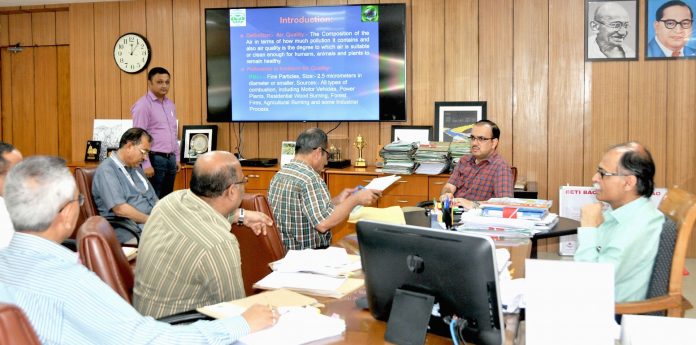
To check rising pollution level in Dehradun, an effective strategy will be formulated. The State Pollution Control Board has been made the nodal institution for the purpose while transport, urban development, forest, PWD and police department has also been associated. A meeting in this regard was chaired by Uttarakhand Chief Secretary Utpal Kumar Singh at secretariat on Tuesday.

S.P. Subudhi, member secretary of the Pollution control board gave a presentation on the monitoring of pollution. He said that monitoring is being done on the basis of particular matter (PM) 2.5, PM 10, Sulphur Oxide (SOX) and Nitrogen Oxide (NOX) content in the atmosphere. Monitoring stations have been established at Clock Tower, Raipur,Himalayan Drug and ISBT.

He explained that there are mainly four causes of pollution namely emission from vehicles, construction activities, open burning and dust on the roads. He said that a system of discarding old vehicles in a phased manner has to be developed and checking of pollution levels of existing vehicles should be done. There is need to encourage E-rickshaw,E-car, E-bus and E-bikes and ban on entry of vehicles in busy areas. There should be complete ban on burning of garbage at open places and garbage lifting should be done at night. He said that Clean Air Asia has selected Dehradun for its effort to check pollution and with their help a better strategy  to check could be made.

D.Senthil Pandian ,Secretary ,Transport informed that piped CNG will be available from December and use of CNG in vehicles will be encouraged. He said that a total of 909 E-rickshaws have been registered and vehicles run on battery or solar power are being given exemption in taxes. A green cess is imposed at the time of registration and renewal of vehicles.

The pollution checking centres have been linked with vehicle-4 software. He informed that there are 25.61 lakh vehicles registered out of which 8.68 lakh vehicles are in Dehradun.he said that two lakh new vehicles are registered every year in the state. There are 103 pollution checking points in the state out of which 26 pollution checking centres are in Dehradun.

Dhol and Damaun: Instruments of Garhwal’s rich cultural past

0

Once a common sight and sound in Garhwal, especially during festivities and marriages. Today a vanishing art form: Dhol and Damaun have been an integral part of every ritual, ceremony and festivity in the hills,  but now, are on the brink of extinction.

December, 2017, I am in Srinagar-Garhwal. For a few moments I can hear nothing. Just the hum of the bazaar and then, rising above it comes the sound of a drum. I follow the sound of the beats and walk into 40 year old Sohan Lal, in a trance. He is amongst the last 50 maestro of this dying art, I find him lost in the world of rhythm and beats.

Sitting around him, on the sprawling University lawn, are students whom Sohan is trying to woo with his gift. This is an art form passed down from one generation to the other, but his children have thrown up their arms in despair, given up music for the lure of jobs.

Catching his breath after half an hour of foot thumping beats, he makes his way to the shade of a peepul tree. The drum rests with the drum-sticks thrust through the side-lacing. I get my pen and paper. My tools of the trade. He understands, and says: “Without any formal training we are all amateurs, spluttering, unsteady and muddled! But with dedication and practice I have learnt a few things and want this art form to be taken up by the young and willing.

He is among a few drummers who have kept the art form alive. Though every village in Garhwal still has a drummer family residing in it. Most of them have all together given up. For there is neither status nor money in this vocation.

For sometime now the Department of folk performing art and culture, in Srinagar, Garhwal has tried to archive and propagate Garhwal’s rich tradition with courses like theatre, folk music and folk forms imparted by the likes of Sohan Lal, masters in their fields. Prof. D.R. Purohit, has been relentlessly working for over two decades now patronizing drums and drummers tells us, ‘We have put in our sincerest efforts to pass on vanishing art forms onto the new generation. We have been training our students by the masters of traditional folk arts themselves, who in turn get an opportunity to show case their talent and get monetary benefits as guest faculty.”

At a meeting of the Uttarakhand Tourism Council in Mussoorie, former Chief Minister,  Harish Rawat had announced a corpus of Rupees Five Crores for restoring the glory of the Drums of Uttarakhand, which gave a shimmering of hope for the sound of the drum to beat out a rhythm in the hills and valleys of Uttarakhand, but that too has passed by, just like the Alaknanda in Srinagar, to make the Great Indian Plains fertile.

Trivendra Singh Rawat congratulates Deepak Ale

0

Uttarakhand Chief Minister Trivendra Singh Rawat has congratulated Deepak Ale, a resident of Uttarakhand and serving as a soldier in Indian army for getting the coveted ‘Shaurya Chakra‘ gallantry award.

Chief Minister said that Uttarakhand has a rich tradition of valour and the state is proud of its brave hearts.  He further said that the award of ‘Shaurya Chakra’ to Deepak Ale is a matter of pride for Uttarakhand. The Chief Minister said that the brave people of the state are always in the forefront of defending the country.

It is to be recalled that during his deployment in Keran sector of J&K on April 09,  2017, Deerpak Ale ,a jawan of Indian army by his bravery and presence of mind thwarted an attempt by terrorists to infiltrate into India and killed two terrorists.

Chief Secretary Utpal Kumar Singh receives first electric car in secretariat

0

The representative of Union Government enterprise, Energy Efficient Services Limited (EESL) handed over a key of first electric car to Uttarakhand Chief Secretary Utpal Kumar Singh at a function held secretariat.

Secretary (Finance) Amit Negi took a test drive of the car. Chief Secretary said that emission of carbon dioxide would be lesser through E-vehicle. He said that E-vehicles would be introduced in the state in a phased manner to check pollution and manufacturing cost.

He said a fleet of 20 vehicles would be received from EESL in the first phase. Secretary (Power) Radhika Jha informed that EESL would charge a fare of Rs 38,000 per month including driver’s cost. She said Rs 15 per day would be the cost per day to charge one vehicle. The vehicle would be run at a cost of 28 paisa per kilometre and the car would run 140 km when fully charged.

It may be recalled that Union Government has set a target to launch 60-70,000 electric vehicles by 2020 and national electric mobility plan has been launched for it.  With the use of electric vehicles instead of internal combustion engine vehicles, the import of crude oil would be decreased which would finally lesser the financial burden on the government.

The carbon footprint would be also controlled and the carbon dioxide emission would also decrease by a total of 5.6 lakh tonne. State Estate Officer Vinay Shankar Pandey, Director (UREDA) Arun Tyagi were present on the occasion.

Dudhli to soon become Uttarakhand’s first digital village

0

Dehradun, Dudhli village is set to become to the first gram panchayat in Uttarakhand to be fully wifi. Work is on war-footing in Doiwala with fibre optics cable being laid and utility poles being installed. The work is being carried out in Doiwala which is also Chief Minister’s Trivendra Singh Rawat’s constituency. The project is being carried out under Centre’s Digital India Scheme and should be operative by the end of this month.

The initiative of turning Dudhli wifi was taken up by Social Activist Ajay Kumar who wrote to the PMO on 1st of June 2016 seeking internet connectivity for his village. The PMO  took note and assured him that the village would get internet facilities as soon as possible. The existing internet connectivity provided by mobile operators in the area was very poor.

Just a month back, around mid-March,  a team of#CSCegov under the Ministry of Information Technology  had surveyed Dudhli gram panchayat for setting up wifi facility, and within a short span of time, the project is nearing completion.

Talking to Newspost a while back, Gram Pradhan Hari Thapa had said, “we want to bring facilities available in town to our village as well and this initiative is a small step in that direction.”

Keeping the faith alive: Sarita Panwar

0

‘To lead by example,’ a phrase that people seldom work upon, but then, there are some amongst us, who live up to this phrase. Setting an example as an acting principal of a Government Primary School, posted in block Augustmuni is Sarita Panwar who choose to take her school children out of Kendra Vidyalaya and had them admitted in the Government School that she recently took charge of.

In 2014 October, a resident of Roorkee Sarita Panwar, joined as an Assistant Teacher at the Government Primary School in village Beeron-Deval, Augustmuni, Rudraprayag, and then went on to become an acting principal of the school in December last year.

In April this year, Sarita  withdrew her two children Trisha and Abhinandan who were studying in Kendra Vidyalaya Augustmuni and admitted then in class 3 and 4 in her school, a step which is being praised by all those around her.

Sarita shares with us, “My kids are different, they accept things easily and are happy in every situation, there are teething problems, but there are no complaints. My family wasn’t too happy initially but then they have supported me wholeheartedly.

Why this change of school? We ask her, she replied, “I work in this school and give it my 100% so why cant my children study here and get a good education as well? I took this step keeping in mind my children’s intellectual welfare, I want them to learn and be equal with their classmates.” 

In times when lack of teachers or students and in some cases both, Government Schools in Uttarakhand are struggling with depleting standards of education, where parents  prefer private education to government schools, the likes of Sarita Panwar and her children give that much required hope, that all is not yet lost and there is light at the end of the tunnel.

The resourceful face of the armed forces

0

It is an incontestable fact that no nation can survive, leave alone progress without the resourceful outputs of it`s armed forces. Be it on the field of battle or using its disciplined and organised man-management to overcome natural or man-made disasters etc, armed forces are indispensable.

Eco Task Force:

On the socio-economic development front, one takes the example of the Eco–Task Force of the Indian Army. A considerable number of Eco Battalions were established in 1970s  by the Indian Army to look after the dwindling vegetation along the slopes of Garhwal and Kumaon region. The once barren slopes bereft of any vegetation are now covered with trees and soil-holding vegetation.

Besides the Eco Task force one can see vast formation of Border Road Task force BRTF managed by the serving officers and men of the armed force Engineer regiment and hired civil labour. These formations have undertaken vast projects for development in the Northern, Eastern and Western borders.

National Food &Grain Management force (NFGMF) 

Perhaps no problem is as alarming and shocking than to see tons of food grain (Wheat, Rice, Pulses and various vegetables) rotting in rain or heat while millions of people suffer from hunger and shortage of food in the markets. This problem arises due to lack of storage capability, transportation along with hoarding and black marketing.

Indian armed forces, particularly the Army has a section called the Supply or the Army Service corp (ASC). ASC has a very efficient system of procurement,storing, transportation and even supplying forces deployed in remote regions.

Hence,  it would be a viable suggestion to raise extra ASC battalions required for the National task. Expertise from retired personnels trained could be taken into consideration or recruited for the job through a special sanction of the Government.

These supply battalions could be located state-wise with required storage space and transport system. Commanding officers in communication with state authorities, liaising with District Collectors who have the authority on the local grain markets could be a starting point. Perhaps, a system could be put in place where an admin procedure could be chalked out by the Army and State Officials for the sale of the food /grain, without the involvement of any middleman /agent.

Until recently Indian Army had a special corp called the Corp of Military Farms, along with Dairy Farms to meet the requirement of Milk and Butter for the Armed forces where possible, is something that could work as a possible example for civilians and aid state administration in aspects connected to this model.

Railway Territorial Army (TA)  Force :

Indian Railways has a very effective military arm called the Railway (TA) force, where the Railway officers trained by Territorial Army became full-fledged soldiers during Wars especially the 1971 war. Their work included laying railway lines as well as running trains in the Tactical Battle Areas. The laying of railway track in Munabao and Naya Chor line in Pakistan held territory in Rajasthan won them laurels and gallantry awards.

Our vast borders with China are in dire need of rail tracks and communication system, this is where Rail TA system could be put to use in conjunction with personnel of Indian Army Engineers.

This collaboration could give much required boost to the ‘look-east-policy’ of the country, where Indian Rail System would go beyond Mayanmar bringing with it socio-economic development of the region as well.

Starting with the Youth 

The youth in his formative years is an admirer of the soldier of the Indian Army as well as appreciative of military as a profession. The closest a young student gets to the profession of military is through NCC or the National Cadet Corp.

In the late sixties when NCC was compulsory for schools and colleges, these cadets contributed effectively during the 1962 and 1965 wars  as escorts to Military Logistic trains, convoys of civil truck, escorting refugee columns as well as aiding police and administration in times of need. Why these practices got diluted makes for interesting study but attempts should be made to revive and renew this rich tradition.

Young India Military Corp (YIMC)

YIMC could be a regular source of supply to the armed forces if students want to be in the forces, or else go ahead to be a First grade citizen with excellent training to face the task of nation building. YIMC should be headed by a Lt Gen rank officer from the three services and be placed under IDS Integrated Defence Staff.

This vast reservoir of capable National manpower would not only become the second line of defence, but also contribute towards Nation building, proper governance, law and order , regional security, protection of vital areas, rural development programs, upgradation of environmental, health and cleanliness and aid during natural disasters as well.  In the longer run, the organization of Home guards could become a part of this to give it an added punch .

India has such a vast reservoir of Youth power waiting to become a part in the upliftment of the Nation. The points discussed in the preceding paragraphs would only bear fruit if the youth of India is at resonance with the suggestions put forward for the development of the Nation.

Author Ganesh Saili honoured at Raj Bhawan, Dehradun

4

Mussoorie born author-photographer, Ganesh Saili was a special guest at a select gathering of authors, journalists and intellectuals at the interactive session at the Sixth Writers Meet held at Raj Bhawan Dehradun.

Welcoming Saili to the Raj Bhawan, His Excellency the Governor of Uttarakhand Shri  KK Paul called the author, “A  historian from  the hills who could illustrate his words with his own pictures.” The Governor also talked about the author’s latest book ‘Wanderings in the Garhwal Himalaya’ and other books Ganesh Saili has written.

The celebrated author, spoke about his roots, his home in Mussoorie, interspersed with interesting anecdotes – ‘Gupp & Gossip’ – tales of  life in the hills which had the audience in rapt attention, with self deprecating humour.

Ganesh Saili has also made his mark as an ace Photographer and he put together a stunning collection of photographs for his audience categorising them under his roots in the Garhwal Himalayas, his home in Mussoorie and the journey down the years from analogue to digital.

Present at the occasion were authors Jaskiran Chopra, Roshan Dalal, Mona Verma, Director General of Police Anil Raturi, Principal Secretary Radha Raturi, Publisher Upendra Arora of Green Bookshop, Randhir Arora and other.

For years now Uttarakhand’s Governor His Excellency Shri K.K. Paul has played the perfect host by turning, Raj Bhawan, Dehradun into an abode of letters with panache, class, culture and literature.  An initiative appreciated by all men of letters who flock there and look forward to these meeting of intellectual minds.

Mussoorie Zipline, 600 mtrs of sheer adrenalin rush!

0

Mussoorie a tourist destination, until last year had but little to offer to the new age travellers when it came to adventure. Today, the hill-station is slowly but surely making its way on to the adventure map. Cycling; rappling; quad bikes, see-ways on rent and adding to this is ‘Zipline.’

Situated at the Mussoorie Lake, is the town’s much – sort after Zipline, 600 mtrs of sheer adrenalin rush! The zipline operates 365 days a year, from 9:00 am to 7:00 p.m at night, with special offers for larger groups.

On any given day, you will find a queue of enthusiasts patiently awaiting their turn as they zip through secured by a full body harness and a double layer braking system, leaving no place for error.

Our guide for the day, Dev tells us, ‘We are a total of 6 people who took a crash course in the month of March and since April 8th we have been operating commercially. Meant only for people over the age of 4 and under 90 kgs we have been sending people down the line to get a real high on adventure.

Sudhanshu Rawat, the person behind the thrill tells us, ‘it took us close to a year 3 months to get this thing off the ground. And it’s been running really awesome as of now. We have people zipping from every background, the oldest man who zipped with us was 75 yrs of age and the youngest one was this 5 and a half year old girl. It is quite interesting that we have more women clients rather than men.

We meet Nilanajana Singhroy from Hyderabad, a 11 year old, hesitant yet excited as she is all belted up for her first zipline experience, she says, ‘I am excited as I heard so much about it from my cousin, but am a bit scared too as it is my first time on the zipline.’ When we meet at the end of the line, she is thrilled and proud of her achievement, its not always that you get to travel 600 mts in a blink of an eye!

Five crore each to every District for Disaster Management:CM

0

Uttarakhand Chief Minister Mr. Trivendra Singh Rawat has instructed to release a sum of Rs. Five crore each to every District Magistrate of the state before the start of rainy season to meet any disaster in their respective district. The Chief Minister gave this directive while chairing a meeting of the State Disaster Management Authority held at state secretariat here on Friday.

Addressing the meeting, Chief Minister said that local people have an important role to play in disaster management and they should be trained in dealing with any kind of disaster. He said that those Mahila Mangal Dals and Yuvak Mangal Dals which had already been given disaster management training should be retrained.  He said that the requisite equipment required for disaster relief and safety should be made available at the local level. He also called for strengthening of the Incident Response System (IRS) and early warning system.

Chief Minister Mr Trivendra Singh Rawat said that special care should be taken of the areas prone to disaster. He said that areas vulnerable to earthquakes should also be identified and methods of effective disaster management and relief in those areas should be implemented. He also called for developing ballon technology for communication facilities in remote areas. He also inquired about the preparations of disaster relief and safety measures taken during night.

 The Chief Minister also inaugurated the website of State Disaster Management Authority (usdma.uk.gov.in) and launched the mobile app related to Incident Response System (IRS) on the occasion.

He also released standard procedures, IRS coffee table book, Yuvak and Mahila Mangal Dal training, Disaster Safety Mitra Yojana and IRS checklist booklets. He also presented an amount of Rs. 25,000 and certificate as reward to Narendra Tomar who had won a logo competition of the State Disaster Management Authority.  The Chief Minister also honoured the youth who helped in search and rescue operations during disaster.

DGP Anil Raturi said that after the natural disaster of 2013, State Disaster Response Force (SDRF) has been formed. He said that presently SDRF personnel have been stationed in 50 police stations of the state. There are four companies of SDRF and it has rescued 4858 people in 341 small and major disasters in the state. A total of 35,000 children have been given general training to meet disasters while 8500 children have been provided intensive one month training.

Secretary Disaster Management Amit Negi gave a detailed presentation on the preparations to meet any disaster. He said that 900 women groups at the village level have been trained for disaster management. He said that all the District Magistrates have been asked to conduct GIS mapping of their respective districts and 350 sensitive spots have identified.