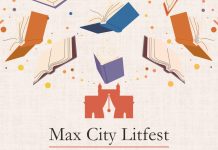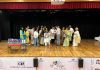
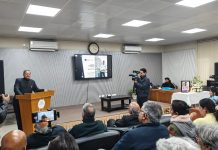








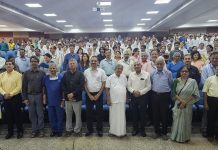



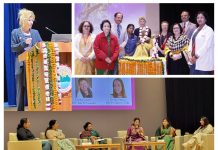

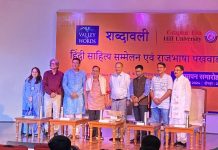
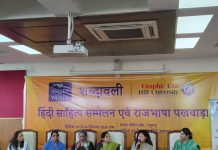
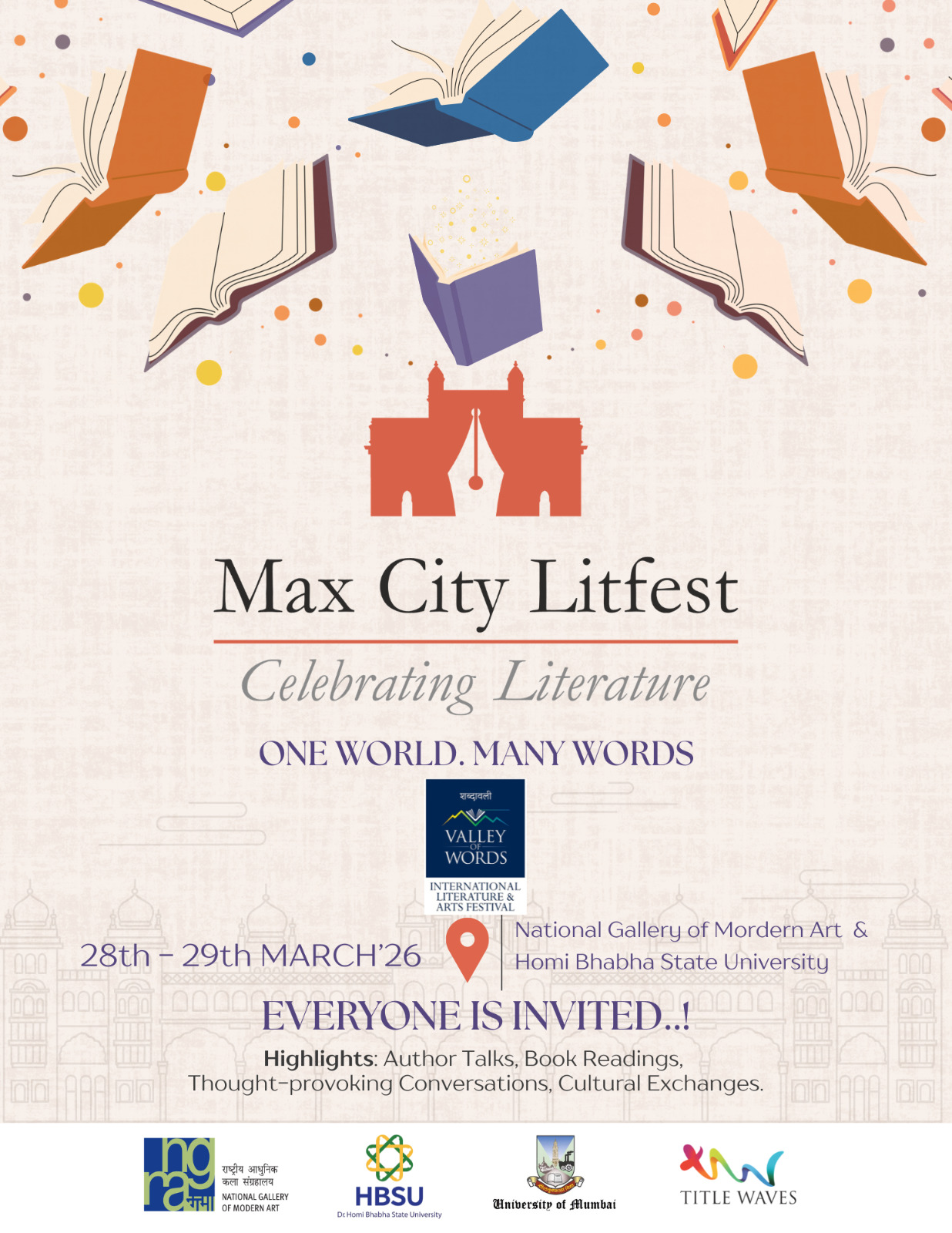
(In lieu of the weekly book review, I am sharing with my readers, the key points of my Keynote address at the Max City VoW Litfest at the National Gallery of Modern Art, Mumbai last Saturday, the 29th of March)
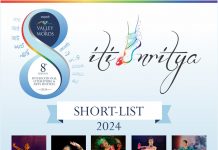
At this MaxCity -VoW Litfest, let me dwell on the theme ‘One World, Many Words’, and on MaxCity and VoW! The key word of course is the ‘word’ – for nothing can exist without it. And then we shall try to understand its relation to the world, the host city and VoW – the organization which has extended its curatorial support to this festival. So, from the Valley of Words, it is now Words on Waves, for the maritime History society of India is a partner in this endeavor.
As this is the Easter Week, let me take a moment to recall the Gospel (King James version): In the beginning was the Word, and the Word was with God, and the Word was God. Thus, it was the word which created the world. In the Vedantic tradition, the relationship between the word and the world is more nuanced. The eighth chapter of the Bhagwad Geeta is the Akshar Brahma Yoga. The ‘word’ is called Akshar – the imperishable and the eternal, as against ‘Kshar’ – the temporal which constitutes the world. The Lord Almighty identifies himself with Akshar. In the Sikh scriptural tradition, the word of the Guru (Gurbani) has been elevated to the divine status – the living Guru.The Muslims believe the Holy Quran to be the literal, uncreated word of God (Allah) revealed in Arabic to the Prophet Muhammad. For the Jews the Torah is the word of God.
Thus, in both Judaic and Brahmanical traditions, the word is Supreme. For it is this word which helps us define our world. As civilizations evolve, we need more words in the lexicon to explain the many different nuances. For that matter, the foundational architecture of all of AI – Grok, Chat GPT, Gemini and Deep Seek – is the large language model – based on the algorithm of the most probable sequence of words.
The World We Inhabit
What is the nature of the world we inhabit? Well, at one level it is just one world – even though every single individual would have her own way of describing it. But we have to remember that even though there is one world: there are an infinite number of world views – and infinite ways to describe them. Words are evolving all the time to get to the most proximate understanding of the world. However, even when the world has transitioned from that particular reality, the words used to describe an extant circumstance continue to live long thereafter. It is true that words can change their meaning over time, the frequency of their use may come down- but the word can never really become a vestigial organ. It is though words that memory is preserved, and memory is the seed from which great literature is created. Not every seed germinates, but even those that do not, become part of the value chain and find a manifestation. Nothing is ever lost!
As this Litfest is being held in the Maximum city, let me also talk about Suketu Mehta, the author of the eponymous book on this metropolis, for it also lends its name to the festival. This descriptor has stuck to the city, not because it was notified in the sarkari gazette, or the manifesto of a political party, or a resolution of the legislative Assembly. It is Max City Litfest, for this resonates well with the city: its joys, its frustrations, its ambitions, its glamour as well as its grime. It encapsulates the agony and the ecstasy of its teeming millions, as well as the elite layers because everything this city does is ‘maximum’, which the Gen Zee now call Max!
This is the year when the Census of India is being held after a hiatus of fifteen years, as against the normal frequency of ten. This will bring, in its wake, an empirical verification of two interlinked anecdotal truths: that India is urbanizing and India is now home to large swathes of interstate migration – thereby bringing some dissonance between the state and the society. This is so aptly captured in Mehta’s recent book This Land is our Land: An Immigrant’s Manifesto in which he shows how metros and cultural spaces are created by the intermingling of peoples who speak multiple tongues, wear multiple identities on their sleeve, bring different skill sets to the table and create a new world – which then looks for words to describe it – thereby creating a virtuous cycle of words and the world !
Let me also share my favourite example about the evolution of words in the English language, and how it has come to dominate the word of governance, banking, commerce, culture, science, technology, peace and war. When Shakespeare wrote his Macbeth and his Tempest, his Hamlet and his merchant of Venice (illustrative examples) in the sixteenth century, he used just about over 30, 000 to describe the entire range of human emotion. When Samuel Johnson published his dictionary of the English language in 1775, he listed more than 40,000 words. But hold on, the Oxford English dictionary of 2026 has over 520,000 entries with 880,000 meanings and the usage examples run into millions.
Let me end by quoting my favorite lines from an exiled poet of this city Salman Rushdie. the closing lines of his Victory City, reads as follows:
I have lived to see an empire rise and fall
How are they remembered now
These kings .. those queens
They exist now only n words
While they lived, they were victors or vanquished, or both
Now they are neither
Words are the only victors
What they did or thought or felt
no longer exists
all that remains is the city of words.