







































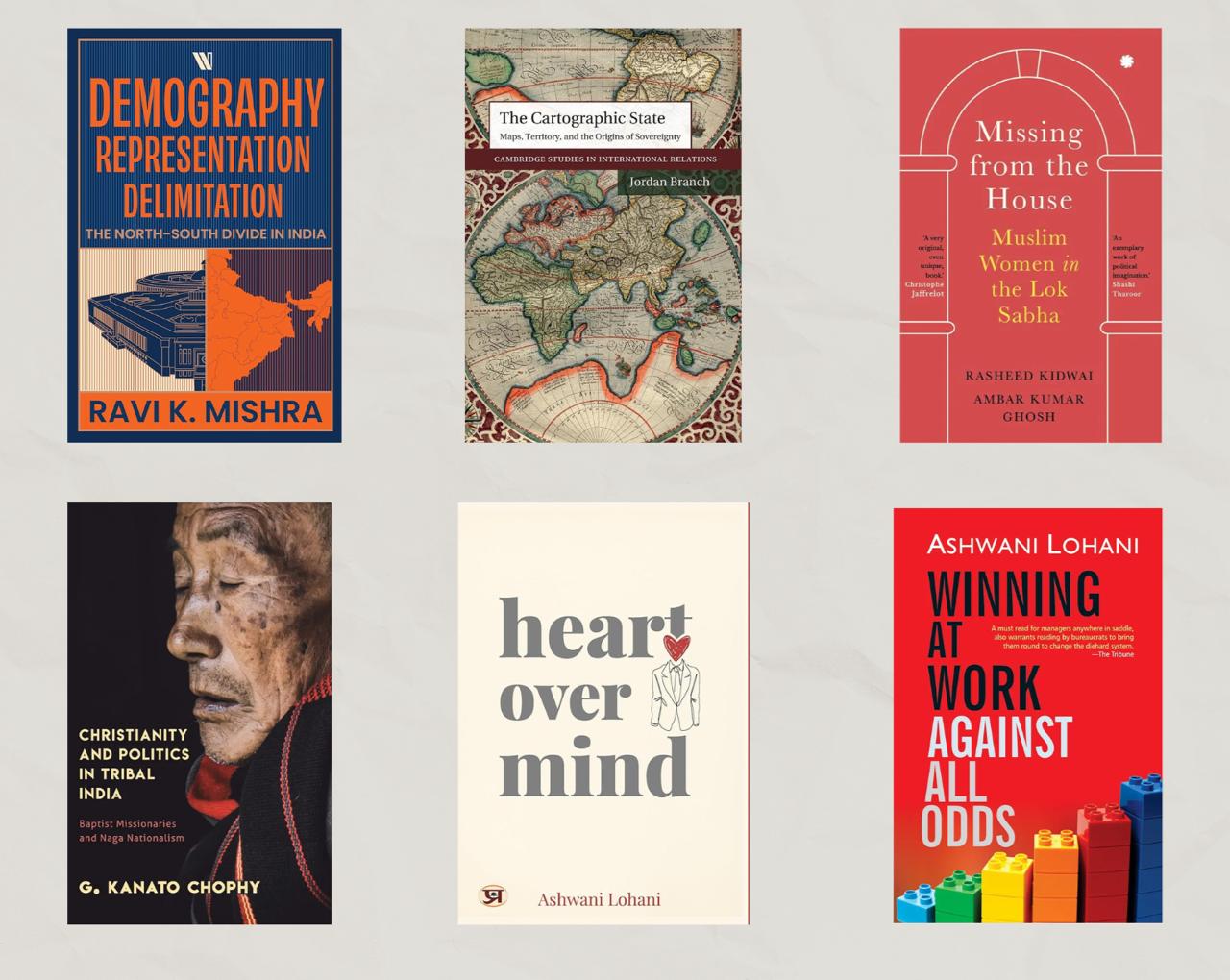
My editors have asked to pen my thoughts on the books that have resonated with me in the course of the year. After excluding the ones shortlisted for the VoW Book Awards in the Non- fiction category, I am focusing on the ones that have impacted my current work on the reorganization of India’s internal boundaries and strategic frontiers, the political questions which contemporary India must answer, and some writings on how to seek excellence in ecosystems that are far from being perfect.
Here are the six books that I wish to list:
Demography, Representation and Delimitation: The North South Divide in India by Ravi K Mishra
As India prepares for the Census 2027 and subsequent delimitation of constituencies, this book demolishes the shibboleths of the southern states losing their democratic heft on account of their better adherence to national demographic goals. Mishra shows that over the last hundred years, the southern states (especially Kerala and the erstwhile Madras presidency) have grown faster: the determining factor is not the number of children born, but those who survive because of improved health and economic indicators. He also points out that the value of an individual vote is much higher in a typical Kerala constituency as compared to UP or Bihar. This is a must-read for informed debate and discussion on the intersection of demography with democracy.
The Cartographic State: Maps, Territories and the Origins of Sovereignty by Jordan Branch
The core argument of this book is that maps define the modern state — in turn, maps continue to shape how people understand the world and their place within it. In the first year of the last millennium (1086), William the Conqueror was more concerned about ‘sources of revenue’, rather than specific area, and it was not infrequent for people to pay their levies to multiple authorities in the same zone, or for the zones to cris-cross different political and ecclesiastical jurisdictions. We also learn of the inextricable connection between map-making, printing, the mercantile expeditions for spices and indigo, and the spread of the Christian faith in the fifteenth century. And by 1588, we have Christopher Marlowe’s play Tamburlaine the Great, in which the titular protagonist proclaims on his death bed:
‘Give me a map; then let me see how much/ Is left for me to conquer the world!
This makes one think of how our perceptions of north and south and down under would change if we viewed the world through a different cartographic imagination. What if the world was depicted with Antarctica at the top and the Arctic at the bottom? Australia and South Africa would dominate the visual, and the island nation which ruled the word for two centuries would appear as minor speck.
Christianity and Politics in Tribal India: Baptist Missionaries and Naga Nationalism by G Kanato Chophy
I came across this book while researching the role of Major Ralengnao (Bob) Khathing in reclaiming the Tawang Monastery in February 1951. He asserted India’s sovereign claims per the McMahon line of 1914 in NEFA or the North Eastern Frontier Agency (as Arunachal Pradesh was then called). Chophy brings out the dominant role of Baptist missionaries in the North East with a special focus on Nagaland, and the Naga tribes outside of the state like for example the Tangkhul Nagas of Manipur. From this tribe have emerged two very important thought leaders representing two extremely divergent viewpoints. The first of these is of course Major Bob Khathing, the protagonist of my forthcoming book; the second is Thuingaleng Muivah, the leader of the NSCN group which has waged one of the longest insurgencies in the world. However, Chophy focuses on how American Baptists transformed the mindscape of the tribes inhabiting the last frontier of the British Raj. One cannot understand the North East – especially Nagaland, Manipur, Mizoram – without a thorough study of Christian politics of this region, or as the author would put it, Christianity and tribal politics.
Missing from the House: Muslim Women in the Lok Sabha by Rasheed Kidwai and Ambar K Ghosh
If democracy is about representation, then the most disadvantaged demographic group is perhaps Muslim women, who constitute at least half of the 175 million Muslim population (14.5%) of the country, and have not had a single member in five of the eighteen Lok Sabhas constituted so far in Independent India. Equally if not more shocking is the fact that that their number has never crossed 4 in a 543 members’ house. A total of 18 Muslim women has ever managed to reach the Lok Sabha, but even within this small number, the majority seem to have entered the Lok Sabha more out of a sense of filial responsibility and a sense of duty towards the patriarch, often stepping in to fill their shoes as daughters, wives, daughters-in-law, and nieces. Hence their political agency, though exercised as leaders, has remained trapped in the narrative of responsibility rather than their own political calling.
Heart Over Mind & Winning at Work Against All Odds by Ashwani Lohani
These two books have been penned by a railway engineer who forayed in museums, heritage conservation, project management, and flagship PSUs like ITDC and Air India. Having made a name for himself in the railways, state and Union governments, he has worked with a wide range of political executives from Mamata Banerjee and Uma Bharti to Ananth Kumar, Jagmohan as well as Prime Minister Modi. Both books make for fascinating reading. They are anecdotal, and each episode is an inspirational story. Take for example the quest to establish a Guiness record for the oldest running steam locomotive, and getting both the Darjeeling Himalaya train and the Mahabodhi temple at Bodhgaya on the global heritage list. Each of the essays has an embedded message: the one which impressed me most was from Transforming a Monolith (Heart over Mind). Richard Branson famously said, ‘For me, my (Virgin Atlantic airlines) employees come first. If I take care for them, they will take care of my clients’. This focus on the employee – be she a flight steward in the airline, or the chef in a hotel chain or an engine driver in the railways – will ensure the transformation of an organization from ‘compliance to commitment’. And for this, the key lies in internal communication, which the Indian railways was able to accomplish through ‘Samvad’ as a structured interaction between the railway officials and the ground level workers. The title of the second book Winning at Work Against All Odds says it all. One has to focus on success even if the ecosystem is not designed for it. The key principles include having ‘faith in the essential goodness of human beings’, for ‘truth always prevails in the final round’ (Satyamev Jayate) if ‘the attitude is positive’. As leaders of large public utilities, ‘the key challenge is deliverance’ which is possible only if we ‘take the bull by the horns’. For this we need ‘leaders with impeccable clarity’ who are eager to ‘adopt and adapt newer technologies and processes’, whether it be IT or the norms of new public management in which stakeholder satisfaction – nay delight – is the cornerstone of all operations.
The chapter which stands out in this book is ‘Decide, not Deliberate’, for this is exactly what my mentor Dr RS Tolia taught me. Administrators must not become victims of procrastination, and even if the decision is not perfect, it is always better than indecision — and if ‘both the heart and the mind’ are in the right place, nothing is impossible!