



































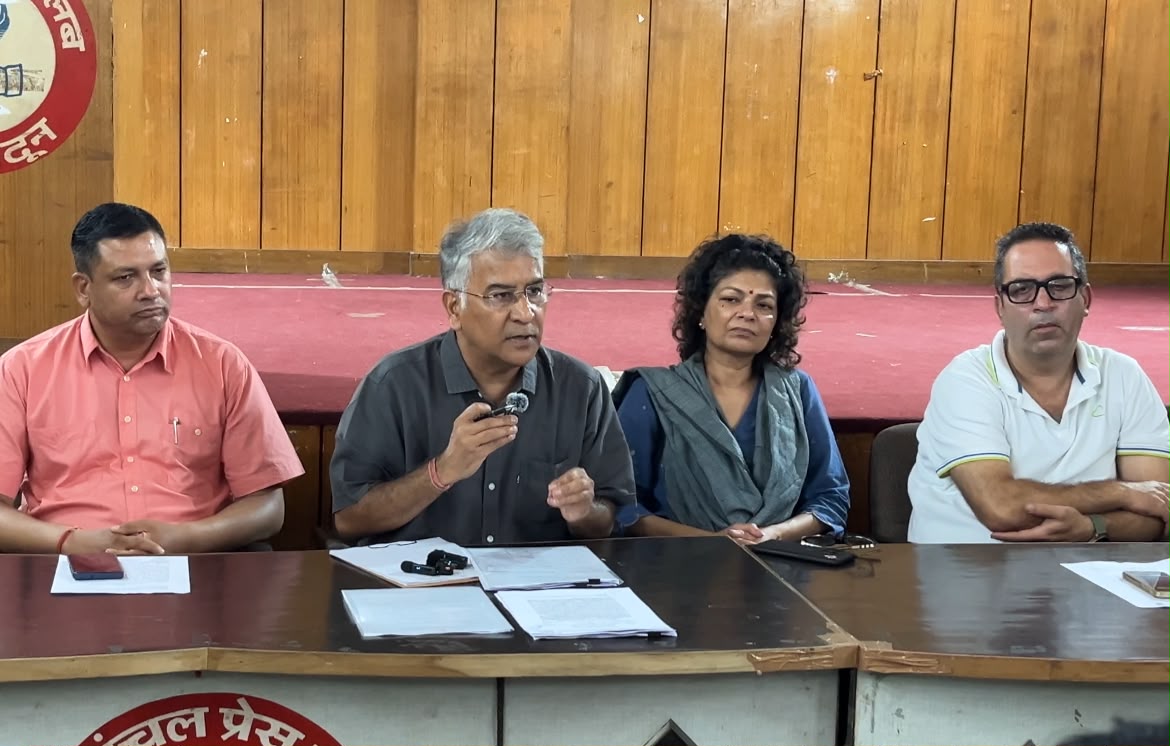
Dateline Dehradun: Concerned citizens addressed a press conference urging the National Highways Authority of India (NHAI) and the Government of Uttarakhand to reconsider and scrap the proposed four-laning of the Rishikesh-Bhaniawala road passing through an ecologically sensitive elephant corridor.
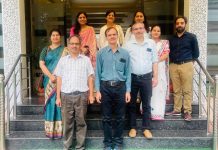
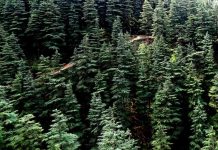
Opening the discussion, Ira Chauhan said that the proposed widening of the highway must be viewed not merely as a road project but as a decision with far-reaching environmental consequences for one of Uttarakhand’s most important wildlife corridors. She said the elephant corridor plays a critical role in maintaining habitat connectivity and that any large-scale fragmentation of forests could increase human-wildlife conflict while threatening the movement of elephants and other wildlife.
Speaking on the legal aspects of the project, Himanshu Arora highlighted the legal concerns surrounding the project, stating that the recent tree felling appears to have proceeded despite the matter remaining under judicial consideration. He explained that while the Uttarakhand High Court had disposed of the Public Interest Litigation earlier this year, it had done so after observing that issues relating to the elephant corridor and tree felling were already pending before the Supreme Court. Arora questioned whether the ongoing tree felling was consistent with these judicial directions and stated that legal remedies, including appropriate proceedings before the courts, were being actively explored.
Dinesh Semwal, a long time resident, stressed that he had never encountered any traffic jams on the road and questioned the very need of the four laning. He further added that local communities have always coexisted with wildlife and expressed concern that increasing fragmentation of forests could result in more frequent encounters between humans and elephants, thereby placing both at greater risk.
Concluding the press conference, Anoop Nautiyal questioned why the National Highways Authority of India had commenced large-scale tree felling during the monsoon season, describing it as a first-of-its-kind instance in Uttarakhand. He said the monsoon is traditionally regarded as the season for plantation and ecological regeneration, making the timing of tree cutting deeply concerning from both environmental and public policy perspectives.
He questioned whether the State Government’s model of balancing economic development with ecological conservation was achieving its stated objectives, particularly in light of the growing pressures on forests, biodiversity and ecosystem services.
The speakers collectively appealed to the Government of Uttarakhand and the National Highways Authority of India to re-examine the project through the lens of long-term ecological sustainability, wildlife conservation and climate resilience.
The citizens’ group also announced the next phase of its campaign. Peaceful protests will be organised outside the NHAI office on July 8 while this year’s Harela festival will be observed as a “Black Harela” to symbolically highlight the large-scale loss of trees and forests in Uttarakhand.