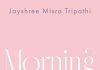

































Morning Twilight: Poems
By: Jayshree Misra Tripathi
(With a Foreword by Radha Chakravarty, Introduction by K. Jaykumar; Prelude by the poet; sectional reflections by Paulami Sengupta, Rachna Joshi, A. J. Thomas, Mandira Ghosh, Satya Mohanty; Epilogue “In the End” by Gopal Lahiri)
“Twilight Poems”, as the name suggests, is a threshold between the private and the public, the moments between daylight and dark, speech and silence, memory and discovery. Jayshree Misra Tripathi’s language is spare and exact, her images are domestic yet capacious, her voice asks us to slow down and notice. In these pages the soft light is turned inward as ordinary objects are transformed into metaphors of meaning through the quiet courage of attention.
Let me begin with an excerpt from my favourite poem in this collection: “The Centre and Me” (needless to say, this is about the India International Centre)
“This is a safe haven for the likes of me,/ with silver-grey hair/ that dances in the gentle breeze.
There is always a kindred soul to greet,/ Programmes to see – dance, music,/
discussions, book launches, art on display – /
the hours pass easily./
Here I am not Invisible./ And my Voice still counts.”
The first point to note is that in these lines, the first alphabets in Invisible and Voice are capitalized. Secondly, ‘not Invisible’ is different from ‘Visible’. Visibility is a metaphor for competition. It is true that ‘not Invisible’ may be the thesaurus equivalent of Visible, but the connotation and context are so different. To me, Visible is morning and Not Invisible is twilight. Similarly, Voice with a capital V is an indicator of presence. And the IIC itself is a platform for meaningful exchanges, an open and safe space for ideas to grow in healthy discourse. Jayshree’s poem reminds us how a space can be both witness and participant — a keeper of small rituals, of meetings and departures, of the hushed work of listening that makes public life possible — like being a Drishta (viewer) as well as a Karta (doer). ‘Invisible’ and ‘Voice’ are a leitmotif in this collection of poems, for in another titled “A Prayer from a Mother”, she writes: “My voice still counts. I am not invisible./ YET.”
Before I delve into the book, let me say that its dedication to the author’s women ancestors – the child brides, the child widows, the grandmothers, her mother and mother-in-law – was very touching and took me back to the loving embrace of my own grandmother and her sister, as well as my mother and her sisters who showered much affection on their ‘first-born son’. Would things have been different if I had a sister – I don’t know, for I am a single child. In this context, the poem “Woman of India” becomes representative of how time has transitioned from our grandmothers’ generation to the contemporary moment:
“Why does this Woman of India/ Love, without condition?/
Why does this Woman of India/ Forgive, without condition?/
How does she grieve?/ Why does she sob behind closed doors?/
When does she soothe her bruises?/ What is she made of? Where can she go?
A few lines later, Jayshree gives us an answer:
Listen to silver–grey words/ from another Woman of India./
In the era of empowerment,/ fight for your rights – /
snap bonds that harm./
Face each onslaught with courage./ Reach out for a helping hand – talk to another, in a safer place./
One Life and you must, and you will, smile again.”
Let us now get to the offerings of “Morning Twilight” in a chronological order, and I will share one or two lines from the poems in each of the book’s seven sections. In the Prologue, we have a poem called “The Composer of Verse”: “And now, it is MY time to seek/ words in concise measures/ to bait my eccentric fancies,/ perhaps nudge my Muse/ from her stubborn stupor.” A faint tinge of regret at having had to sacrifice her academic career to the career ambitions of her diplomat husband comes out as a lament: “Once feted scholar turned housewife/ by circumstances, not choice -/ the decades have swept by,/ yoked to others’ needs, complaints.”
In the section “Angst”, the poem “From a Ladies Coupé” is about “the utter stillness of fear on a train journey” through the Chambal valley, which is later contrasted with “sad-fishing” as the new social media malaise “that mocked genuine vulnerability/ for sharing emotions online”. There is also a reflective poem ‘Why Teach at All?’ which draws from Alan Sillitoe’s classic The Loneliness of a Long-distance Runner.
The next section “Life” has the wonderful poem “He Said, She Said”: “It was dawn/that caused the first rift. I saw darkness,/ he saw the light./ Yet we smiled in unison,/ hiding the pain of incompatibility.”
And there is the sensuous touch in “Mid-life Blues”: “Will you think of me/ when I am gone?/ The grey in my hair,/ spread of my hips;/ the warmth of my glance,/ and crooked smile,/ with its hint of scorn?”
The fourth section is called “Bioscope”. The most poignant lines are a tribute to the love of her life. As immortalized in the poem “She Wore White: In Memory of Sibabrata 1955-2017”:
“I clenched both palms,/ holding our son’s intangible hand,/ he, on his way from a distant continent./ I held her palm in mine. No. Untrue./ I stood alone, hands ajar, propped/ by the Circle of Friends and Family,/ some that loved us, some who did not,/ some Invisible. How will you know?/ And there we stood, she and I,/ Trespassers in the Fold of Tradition./ I do believe you would have smiled/ at our stance! Farewell, Farewell./ The End.”
There is a powerful prose poem in the fifth section “Karmic Lacerations”; in “Capital D”, Jayshree writes: “I no longer fear Death with a capital D, for I have weathered a hundred-odd Deaths at three score eight. Yet here I am. Vulnerable. Alone.”
The penultimate section is called “Windmills”. Here we have a poem called “Solitude” which Tripathi ends with these three lines: “My choices were not for myself./ I crave for the joy of solitude/… to set me free.”
The last section, appropriately called “In the End”, has a poem titled “In Linear Sequence”.
“At birth/ the mind innocent, the heart pure,/ knows no insecurity.
At school,/ the mind playful, the heart curious,/ knows not jeopardy.
An adolescent, the mind insecure,/ questions fickle amor/ seeks the veracity of promises.
As a young lover, the mind/ yearns for permanence,/endures vulnerability.
An adult, the mind matures,/ in matrimony, parenthood,/ learns accountability.
The mind now bolder/ yet fraught with fear, the empty nest,/ now seeks serenity.
The mind even older, aware/ of latent sorrow, the loss of a loved one,/ seeks tranquility.
The mind hardened with known pain,/ Life in all its glory, welcomes harmony./ We are now Complete.”
This is a book to be cherished, to be read at leisure, and to connect with our own individual memories – for at the end of the day, it is this connect to universal experience which makes us truly human. Let us therefore read the book, cover to cover, share it with friends and reflect on the offerings , especially in the twilight hours. It is 4.28 am in Dehradun where I write this, and the twitter of the morning birds is entering my window this morning!