







































In Seeing Like a State, James C. Scott argued that the modern state must first make its people legible, reducing a dense, local world to standard units it can count, map and tax, and that its worst failures came when those simplifications were imposed back on society. I had the privilege of attending a session with him at Cornell, and the argument has stayed with me. There is no better lens for the Indian census — the largest exercise in legibility the subcontinent has known. For a century and a half, it has turned villages, castes, occupations and languages into categories; some illuminated, others hardened into identities.
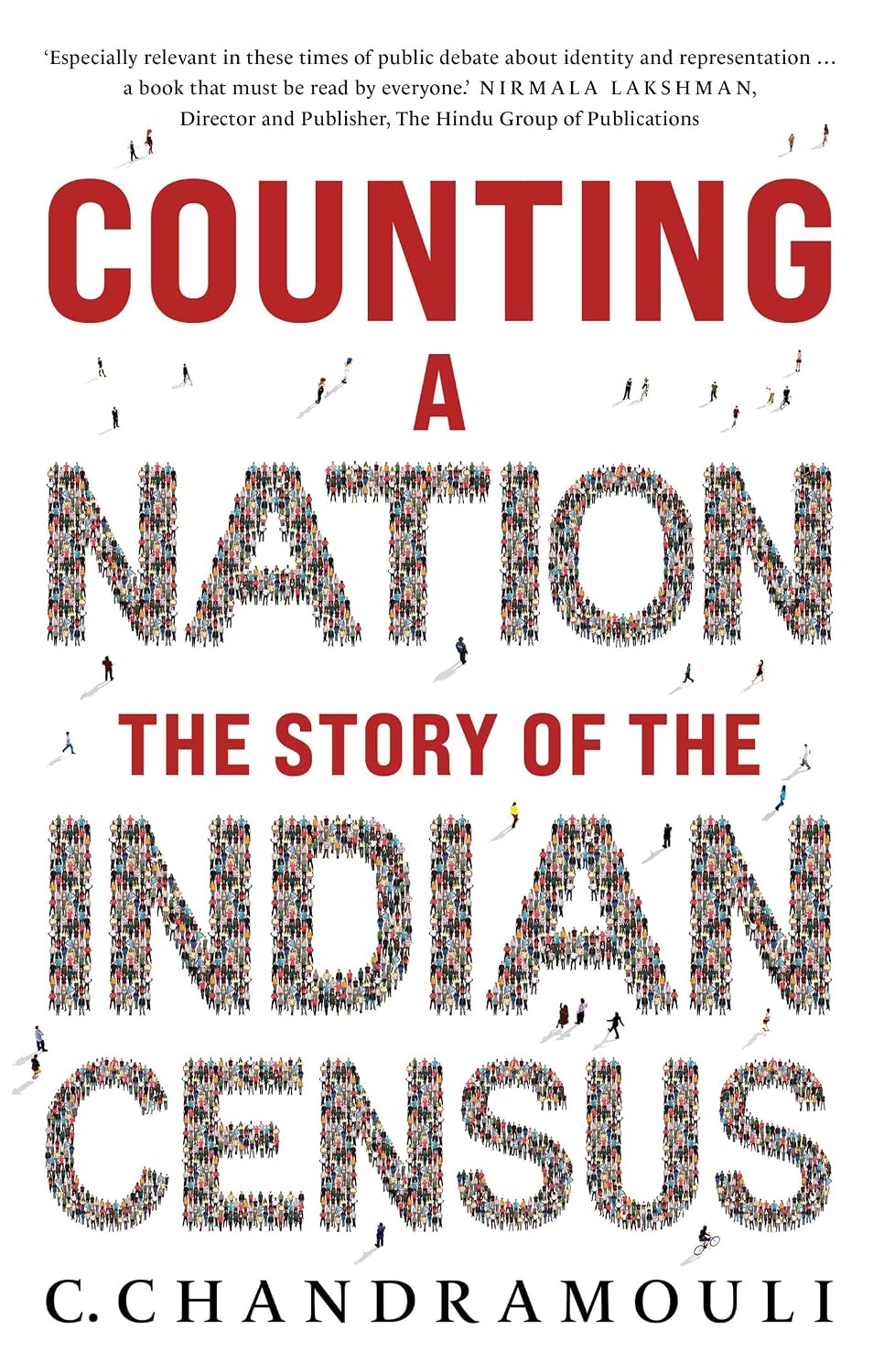
Few civil servants get to write the history of an institution they shaped, and not all Registrars General even get to oversee a census. C. Chandramouli did both: he ran Census 2011, built the first National Population Register and oversaw the Socio Economic and Caste Census. He joins a small line of commissioners who wrote beyond their reports: H. H. Risley, whose 1901 census ranked castes by social precedence and fed The People of India; J. H. Hutton, who drew on the 1931 count, the last full enumeration of caste, for Caste in India; and Asok Mitra, architect of the 1961 census wrote Three Score and Ten. Counting a Nation is easily the most comprehensive study: his book is the ‘ mirror in which the nation sees itself and a map by which it charts its future’.
A population profile transformed
This is also a history of India built not on anecdote or impression but on hard data. In 1881 nearly nine in ten Indians lived in villages, and the 1891 census found that agriculture alone employed nearly two-thirds of the population. Add the artisans, farm workers, herders and service providers whose livelihoods turned on the harvest, and one can infer that nearly 90 per cent depended on the land. Independence changed less than planners hoped: three-quarters of workers were still in agriculture in 1961 and two-thirds in 1981. After the Green Revolution, workers began leaving the land, though for services rather than manufacturing; by 1991 the share was 62 per cent. By 2011, as the demographer Tim Dyson put it, India faced not a population crisis but an employment crisis.
Closely linked is the urbanization story. The urban share rose from 11 per cent in 1881 to about 18 in 1961 and 31.2 in 2011. Census towns nearly tripled between 2001 and 2011, to 3,894: settlements “urban by fact but rural by law.” The urban share may approach 40 per cent by 2027.
India has also become a nation of migrants. Census 2011 counted 45.6 crore people living away from their last place of residence: this was 37 per cent of the population. Most moved within their district, and two-thirds of women moved on marriage, but long-distance flows follow work: Uttar Pradesh, Bihar, Rajasthan and Madhya Pradesh send half of all interstate migrants, and a third of the residents of Delhi and Mumbai were born in another state. Seasonal and circular migrants barely register, which is why the 2020 lockdown, when millions set out to walk home, so startled a state that could not see them.
One of India’s less celebrated achievements is that it is now a largely literate nation. In 1881 over 96 per cent of Indians were illiterate. Literacy was 30.7 per cent in 1961, crossed the halfway mark at 51.6 in 1991 and reached 73 in 2011. The Periodic Labour Force Survey now puts it at 81.1 per cent, though rural women trail at 70.3. Ten states and union territories have declared themselves fully literate since 2024.
Decadal growth peaked at 24.8 per cent in 1961–71 and fell to 17.6 per cent in 2001–11. The total fertility rate is now 1.9, below replacement, yet Delhi is at 1.2 and Bihar at 2.8. With life expectancy near 70, the next challenge is ageing: India is growing old before it grows rich.
Seven censuses, seven lessons
The 1951 census reinvented the colonial census rather than discarding it. After a Constituent Assembly debate led by Sardar Patel, caste was dropped except for Scheduled Castes and Tribes; individual returns were made confidential; and R. A. Gopalaswami’s warning about “improvident maternity” helped launch India’s family planning programme in 1952.
In 1961, Ashok Mitra turned description into diagnosis. Village and Town Directories mapped social infrastructure, and district rankings created the vocabulary of “backward areas.” His retrospective, “Census 1961: New Pathways” (EPW, 1994), recounts his battle with P. C. Mahalonobis, who wanted social and economic data collected by sample; Mitra insisted on a full count, and opened the census office to scholars. His lesson: a census earns its authority from completeness and openness to scrutiny.
1971 is the cautionary tale. Read through the global “population bomb” panic, its numbers fed the Emergency’s coercive sterilization drive. Projections were treated as immutable truths when, as Ashish Bose long argued, fertility falls with education and development, not enforcement. The same anxiety produced the 42nd Amendment, freezing seat allocation so that states which controlled population would not lose political weight. The 84th Amendment, built on NDA–UPA consensus, extended the freeze to 2026. Ravi K. Mishra’s Demography, Representation, Delimitation shows that every region passed through decades of peak growth, only at different times, and that seats could be reallocated without any state losing those it has.
The 1981 census was also held with Ms Indira Gandhi at the helm, but by now enumeration rested on consent rather than coercion. It’s finding that female literacy tracked smaller families made education “the real contraceptive” and Kerala the template for the National Literacy Mission. The failure to count Assam in 1981 and Jammu and Kashmir in 1991 showed that the census depends on political stability. The 1991 census caught a society already on the move: for the first time, work overtook marriage as the main reason for migration.
The 2001 census is best described as the census of rights: its data on toilets, housing, literacy and the child sex ratio shaped the Sarva Shiksha Abhiyan, the Total Sanitation Campaign and tighter enforcement of the PCPNDT Act, and its first disability count informed the 2016 disability rights law. Our author led the 2011 census, whose finding that 47 per cent of households lacked toilets drove the Swachh Bharat Mission. Caste went to the separate SECC, and the NPR ran “co-located, not merged.” His lesson: technology must support, not supplant, trust.
The final third of the book is its most urgent. Chandramouli calls the sixteen-year gap, the only break in a series unbroken since 1872, an “epistemic void.” By 2027 more than 250 million Indians will never have been counted. The NFSA’s beneficiary cap still rests on 2011, and he estimates that around 100 million eligible poor may be excluded. Then there are three elephants in the room. On caste, the question is now how, not whether, and he proposes a Caste Enumeration Act with data-protection safeguards. The count ends the fifty-year freeze on delimitation, where he wants a legal firewall keeping the census office out of map-drawing. And women’s reservation takes effect only after the census and delimitation, so every enumeration error now carries constitutional weight.
Who counts the counters?
Every census and election rest on the government school teacher. Section 27 of the Right to Education Act bars using teachers for non-educational work but exempts the census, disaster relief and elections, the duties that consume them most. A 2018 NIEPA study found government teachers spent just 19.1 per cent of their working hours teaching. The Special Intensive Revision of electoral rolls pulled teachers away for months, and Census 2027’s house listing followed close behind. Anyone who has run a district knows the cost: classes merged, syllabi abandoned, the slowest learners left furthest behind. Self-enumeration, scheduling in vacations, and a cadre of recently retired government employees, NSS volunteers and staff from other departments can share the load. The census asks teachers to make the nation legible; it should not do so at the cost of the children they are there to teach.
In fine, counting a Nation combines a practitioner’s authority with a historian’s range, and ends with proposals rather than lament. As Chandramouli puts it, counting is the first step towards governing wisely. Census 2027 will test whether the Republic still agrees, and whether the ‘state’ can see its people without losing sight of them.