



































India at War: Empires, Battles and the Making of a Nation
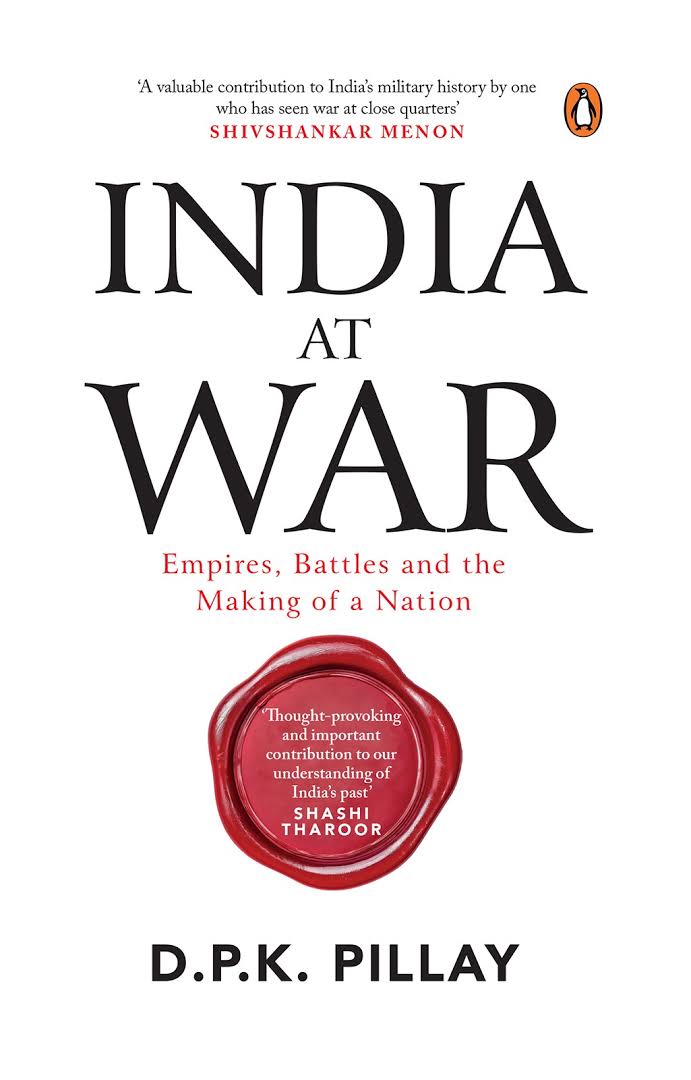
Author: Col DPK Pillay (Retd)
Publisher: Vintage Books (Penguin Random House)
Pages: 368
Price: Rs 699
In his 1961 Cambridge lectures, published as What is History? EH Carr punctured the comfortable belief that the past is a pile of hard facts waiting to be collected. Facts, he argued, are not fish laid out on a fishmonger’s slab but fish swimming in a vast ocean; what the historian lands depends on where he chooses to cast and what tackle he uses. Hence his celebrated advice: ‘Study the historian before you begin to study the facts.’ Col DPK Pillay’s India at War: Empires, Battles and the Making of a Nation reads almost as a test case of that advice. Its target is an old charge, repeated in Whitehall and, more embarrassingly, in some of our own seminar rooms, that India never possessed a strategic culture. George Tanham’s RAND essay of 1992 gave the idea an academic gloss, and it has proved remarkably durable. Pillay’s book is a sustained rebuttal, and it begins by interrogating the chroniclers who built that verdict.
Pillay brings a rare double credential to the task. He is a Shaurya Chakra awardee, a third-generation soldier who has known combat at close quarters, and a doctoral scholar now at the Manohar Parrikar Institute for Defence Studies and Analyses. The book opens with what he calls a confession before the investigation, and the puzzle it poses animates everything that follows: why have the men who fought and bled under Indian, Mughal, Maratha, Sikh and British colours found so little place in the way independent India narrates its own past? The soldier wants them remembered; the scholar wants to know why they were forgotten.
The early chapters take aim at two colonial inheritances. The first is the image of a passive, fragmented subcontinent, conquered because it lacked martial spirit. The second is the ‘martial races’ doctrine that hardened after 1857, when recruitment shifted towards Punjab, the frontier and Nepal, and the Purbiya sepoys who had been the backbone of the Bengal Army fell out of favour. Pillay reads the doctrine for what it was: political management dressed up as ethnography. The argument is not new, but he makes it with the conviction of an officer who has seen courage distributed with complete indifference to the census categories of the Raj. Anyone who has served in Bengal will know how long the ‘non-martial’ label lingered, and how unjust it was. In Carr’s terms, the Raj did not merely interpret Indian society; it manufactured a category, rewarded those who stayed loyal in 1857, and then entered its own invention into the record as fact.
The chapter on classical foundations, titled with a respectful nod to AL Basham, revisits Kautilyan statecraft, the ideal of dharma yuddha, and the coexistence of prosperity with military capacity. This is where the book is most open to argument. An unbroken strategic tradition running from the Arthashastra to the present is an attractive idea, but the gap between the ethics of the texts and the conduct of real campaigns was often wide. Pillay is at his best when he treats classical thought as a resource to draw upon rather than a lineage to assert.
The narrative gathers pace with the East India Company, which Pillay describes without euphemism as a predatory enterprise that turned Indian revenue and Indian soldiers against Indians. Against this he sets a battle most readers will barely have heard of: Colachel, 1741, where Marthanda Varma of Travancore defeated a Dutch East India Company force. The sequel is as instructive as the victory. The captured Dutch commander, Eustachius De Lannoy, entered Travancore’s service and helped modernise its army. Here was an Indian ruler who won, and then learned. That Colachel slipped out of the larger imperial story is itself Carr’s point: an event becomes a historical fact only when someone chooses to tell it, and this one spoiled the tale of inevitable European superiority.
The chapter that follows asks the harder question: if Indian armies could fight this well, why did the regional powers fall one by one? Pillay’s answer, pointing to technological asymmetry, diplomatic fragmentation and the absence of any unified continental command, is sober and largely persuasive. For the policy reader it may be the most valuable chapter, because it is about failure rather than glory, and failure teaches more. The treatment of 1857, and of the deliberate post-Mutiny restructuring of the army to prevent pan-Indian solidarity among soldiers, follows naturally.
Haifa is the book’s set piece. On 23 September 1918, the Jodhpur and Mysore Lancers of the 15th (Imperial Service) Cavalry Brigade charged Ottoman and German positions on the slopes of Mount Carmel, lances and swords against machine guns, and took the town. Major Dalpat Singh, remembered as the Hero of Haifa, fell in the action. Delhi commemorates the charge at Teen Murti; Israel teaches it in schools. Pillay tells the story with evident feeling. The episode also exposes the tension at the heart of Indian military memory, and Pillay confronts it through a telling contrast. For decades the arches of India Gate carried the names of more than 13,000 soldiers who fell in the empire’s wars, while independent India waited until 2019 for a National War Memorial of its own. A young nation, unsure how to honour courage worn in an imperial uniform, chose silence over engagement. Here, too, what was remembered was a choice.
The final third, on Partition and the first Kashmir war, is where Pillay is most assured and his soldier’s eye matters most. He traces the planning behind the tribal invasion of October 1947, Maharaja Hari Singh’s fatal hesitation, the collapse of the state forces and the signing of the Instrument of Accession. Then come the operations: the airlift of 1 Sikh into Srinagar on 27 October; Major Somnath Sharma’s stand at Badgam, which earned independent India its first Param Vir Chakra; the armoured action at Shalateng that broke the raiders’ advance on Srinagar; the long siege and relief of Poonch; and General Thimayya’s audacious decision to take Stuart light tanks over the Zoji La at nearly 11,600 feet.
Pillay’s sharpest contribution, though, is to show how the same ground facts yielded two different stories. Field commanders such as Ranjit Rai, Somnath Sharma, Usman and Thimayya read the campaign in terms of terrain, logistics and mountain warfare. New Delhi read it through bureaucratic filters, a wariness of its own generals, and an idealistic internationalism that carried the dispute to the United Nations before the military objectives were secured. The political narrative prevailed, and with it, Pillay argues, a civil-military divide that hobbled Indian defence thinking for decades. It is Carr’s dialogue between present and past, played out in real time.
What lifts these chapters above regimental history is the attention paid to the less celebrated. Brigadier Mohammad Usman, the ‘Lion of Naushera’, who refused Pakistan’s overtures and fell at Jhangar in July 1948, receives his due. So does Maqbool Sherwani, the young Baramulla activist who misled the raiders and paid with his life. So do the Ladakhi volunteers who held Leh, and the garrison whose long, ultimately doomed defence of Skardu bought precious time. The war, Pillay insists, was won not by generals alone but by a web of soldiers, civilians and local loyalties that no staff college diagram captures.
The closing chapter turns from history to policy. India, Pillay argues, must decolonise its strategic thinking, narrow the old distance between its civil and military establishments, and build doctrine on its own experience rather than on borrowed Western templates. This is the book’s real purpose, and it is a timely one.
There are limitations. Covering two millennia in under 400 pages means the classical and medieval periods pass at a gallop, while the Kashmir war receives a treatment so detailed that it sometimes reads like a different book. The civilisational framing occasionally tips from analysis into advocacy, and readers will want more engagement with recent scholarship, such as that of Srinath Raghavan and Kaushik Roy, and fuller sourcing on contested episodes like Pakistan’s planning in 1947.
But these are the reservations of a reader engaged rather than bored. India at War is passionate, readable and, in places, genuinely illuminating. It should be read by young officers, certainly, but also by those in the civil services, the universities and the newsrooms who shape how the nation remembers itself. Having spent years at the Academy in Mussoorie thinking about how we train those who will govern, I would place it on the reading list without hesitation. Carr asked us to study the historian before the facts. Pillay has done exactly that with the chroniclers of empire, and shown that much of what passed for fact about India’s martial past was, in truth, a choice. A nation that forgets its battles will find others only too willing to write that history for it.
The reviewer is a former civil servant and Director, LBSNAA, and the author of ‘We the People of the States of Bharat’ and The Great Conciliator : Lal Bahadur Shastri and the transformation of India . Views expressed are personal.
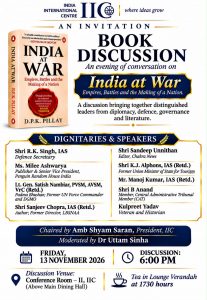
Book launch will be held at 5.30 pm at CR 1 of IIC on 13th November, 2026








 Published by Vintage Books)