































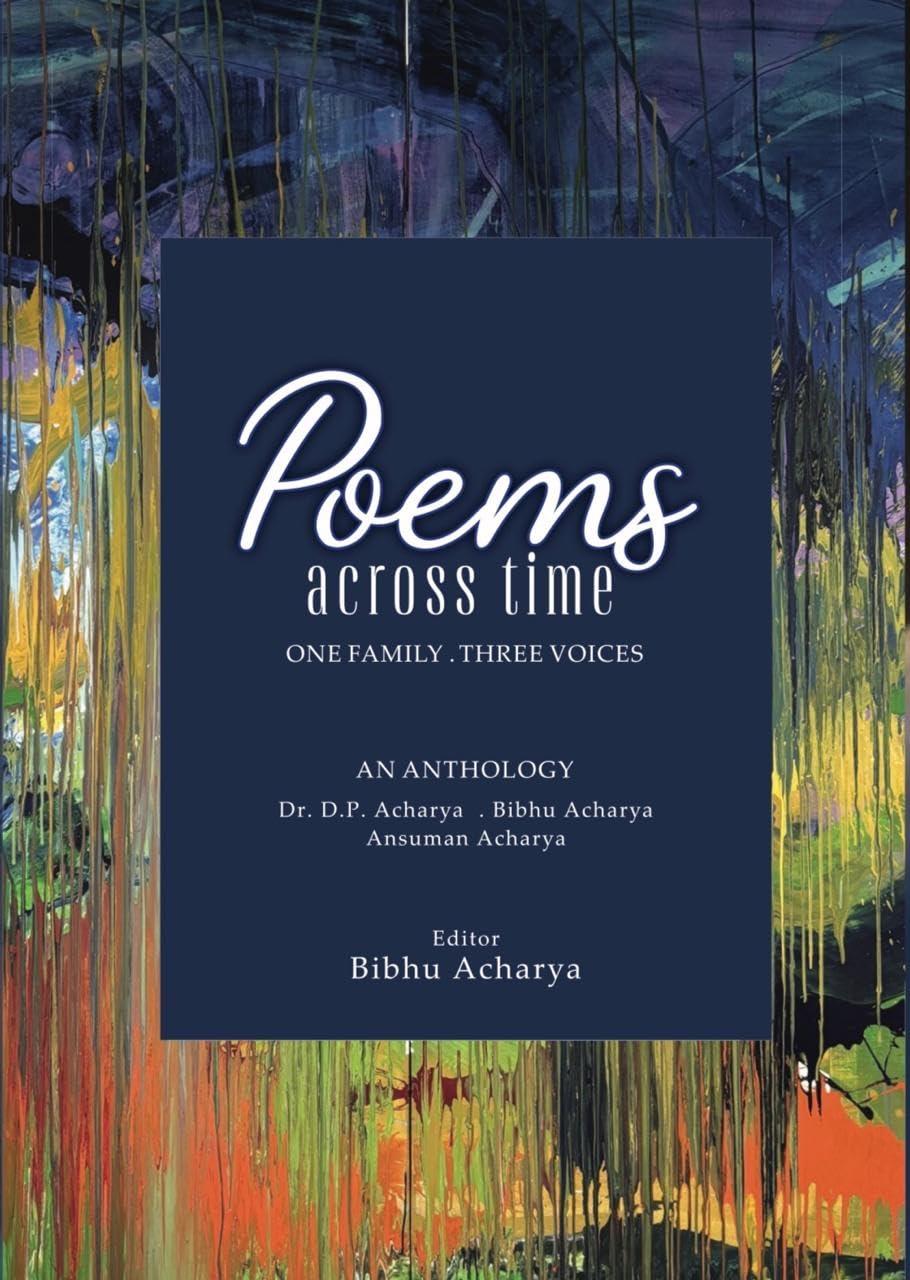
By: Dr DP Acharya, Bibhu Acharya (Ed.), Ansuman Acharya
This is a remarkable collection of intergenerational and intercontinental poems from the distinguished Acharya family. Edited by Bibhu Acharya, who is well-known to readers for his hard-hitting cartoons on contemporary polity, as well as for his book of cartoons on his life as a civil servant titled Obtuse Angle. This slender volume is a tribute to his late lamented brother Dr DP Acharya — a surgeon who died at the young age of forty-five in the year 2000. In addition to DP and Bibhu, the third contributor is DP Acharya’s son Ansuman, now settled in the US.
The genesis of Poems Across Time lies in the discovery of Dr DP Acharya’s blue diary, with his poems written from the late 90s, during a spring cleaning by Bibhu’s wife Ranjeev last year in 2025. This set the editor thinking that there was something literally “Akshar” (eternal) about poetry, and perhaps the time had come for 35 of DP’s poems to reach a wider audience. These are contained in the section “One with the Ocean”: ‘In the tumultuous waves of/ Brahma’s ocean/ your image you see/ in the ocean itself,/ You were meant to be / Vast and serene’. The God of Creation, Brahma appears in another one of DP’s poems titled “The Awakening” where he writes: ‘Eternal awaiting,/ Eternal awakening…/ Someday when/ Brahma creates the earth…’
From the same section, let me also share the poem “Time Waits at Times”, about rivers and love. Though all rivers flow into the ocean, love lives on! ‘Life is a river,/ It flows…/ Love flows on,/ with loving memories,/ of great times,/ we shared in the/ Year that is passing’. In other words, while it is impossible for a river to retrace her path, our memories can and often do travel back in introspection, in anticipation of friendly tidings.
We now come to Bibhu’s 57 poems in the section “Caught in Passing”. Many of these poems were written in a journal presented to him by Ranjeev. These are reflective of how a bureaucrat walks the tightrope of political pressure and public expectations while trying to keep his conscience (and humor) steady.
I will start with the poem “Tribute to Tibet”, for as I discovered during my research on maps and milestones in the making of India’s history, Tibet had disappeared from the cartographic imagination of India from 1952 to 1959. That is why Bibhu writes, ‘If you can’t still find it,/ in the atlas/ Look within / For it is / A state of mind…’
In October 1999 when the tsunami wreaked havoc in Bibhu’s Janmabhoomi of Odisha, he wrote: ‘The cyclone cleared everything/ cobwebs and concerns,/ Miseries and Milestones, Beliefs and Bridges/as, if/clearing the deck/ for a new beginning in the Millennium.
On February 1st, 2023, Bibhu penned his tribute to Kalpana Chawla. Called “Lost in Space”, it reads, ‘Don’t look for/ in the debris scattered/ over the sands of Texas,/ Look up and find her/ if you can, among the Brightest of stars, twinkling / High above in the sky… ‘
Every batch of the IAS returns to the Academy, time and again, to mark their Silver, Ruby and Golden reunions. In August 2008, when his batch came for its Silver Jubilee, Bibhu wrote an “Autumn Sonata”: ‘Twenty-five summers, and winters,/and a few seasons of spring, too…/ As we approach the autumn/ looking back with nostalgia,/ on the journey that/ began in the balmy climes of/ Charle Ville nestled in the/ Blue mountains of Mussoorie.’
Bibhu’s mentor and guide, the Odiya poet Padmashri Chandrashekhar Rath, to whom he has dedicated this section of poetry, was indeed quite impressed with this poem, which includes a wry note on evolution: ‘Metamorphosed from skinny youngsters/ with eyes fired by idealism/ Into overweight hypertensive/ pragmatic pen-pushers/ with dissipating spines. Rath’s comments on this poem are worthy of recall: ‘Late in the afternoon,/ floats a forgotten note on the flute/across misty valleys unknown/ luring you to dreams,/ softly breaking the silences/ From the depths of sleep.’
The third section is by the 1987-born Ansuman Acharya. Born in Bhubaneshwar, educated at NIT Rourekela and the University of Washington at Seattle, his interests cover a wide spectrum: from poetry to music to nature trails and the lead singer in the Nirvana inspired The Neverminds band in his karmabhoomi of Seattle. In the introduction to his section “Mundane to the Monumental”, Ansuman questions what it means to belong. What does it cost to dream? And most importantly, when does the ordinary become extraordinary?
The opening with “Gratitude Unbound” takes us back to his father’s poem on the Ocean: ‘Sat by the ocean, blowing with the breeze,/ obsessed with progress , this day we must seize…/ if and but, how and when , pensive pangs of indecision/will they thwart, or eventually aid our mission/
Wisdom does not necessarily come from well known seers , or self-help books. For to Ansuman, the best life lessons came from a conversation with an Uber driver. He writes, ‘As with most wise men, he had travelled far and wide,/ and spent his life with purposeful action,/ by humans and nature alike…/ curiosity, erudition and courage encumbered his tales,/ as I carefully listened , his voice rang my mind’s bells…’ He goes on, ‘He taught me to be my better self ,/one that only gushes with peace,/contentment and ambition balanced with ease.’
Now these are powerful words to reflect on: if one can achieve this balance of contentment and ambition, one is a Karamyogi in the trust sense of the term. Thank you, Bibhu, for resurrecting the poems of your brother – the Independence generation, and connecting us to the world of the millennials.